

Glasgow bus delays costing passengers 1.2 million hours a year
First Bus calls for a collaborative partnership approach on bus priority as Pollokshaws Road named worst congestion hotspot
Glasgow’s traffic congestion is costing local bus users an estimated £24 million a year and wasting 1.2 million hours of passengers’ time annually, according to new research by the University of Glasgow’s Urban Big Data Centre, commissioned by First Bus.
The study, The Price of Bus Delays in Glasgow, finds that delays on five key corridors are stretching peak-time journeys significantly and undermining reliability for people travelling to work, education, shopping and healthcare.
The research highlights Pollokshaws Road as Glasgow’s most severe congestion pinch point for buses, with an estimated 375,577 passenger hours lost every year - valued at £7.45 million.
The report identifies several corridors where congestion is having the biggest effect on bus performance and passenger journey times:
- Great Western Road: afternoon services particularly vulnerable to delayed departures
- Pollokshaws Road and Maryhill Road: largest increases in travel times during peak periods - up to 40% longer in the afternoon versus uncongested conditions
- Pollokshaws Road: greatest overall congestion impact - 375,577 hours lost annually, worth £7.45 million
Andrew Cullen, Regional Director for First Bus in Scotland, said: “This is about more than buses; it’s about Glasgow’s future prosperity. Congestion is quietly costing customers £24m a year and holding back productivity.
“And this is just people using the bus in selected parts of the city, which shows the overall financial impact will be much higher. Every minute we save for passengers is a minute they can spend working, learning, shopping, or enjoying the city. It can also help to attract more people to think of using the bus.’
Targeted intervention proven in other cities
The report concludes that targeted interventions such as dedicated bus lanes, bus gates, and traffic signal priority proven from other cities can deliver substantial improvements.
Aberdeen’s bus network has seen punctuality improved by up to 12% and journey times cut by 17% since the introduction of bus gates in 2023. A similar level of time savings in Glasgow would be worth around £3 million annually.
Polling released last week by the Confederation of Passenger Transport Scotland, the bus industry body, found that 58 per cent of people support bus priority measures such as bus lanes, bus gates and traffic light priority to combat congestion. Support was strongest in urban areas such as Glasgow.
Beyond the immediate frustration for passengers, the University of Glasgow research also discusses the wider ripple effects:
- Higher operating costs for bus services (staffing, fuel, fleet size).
- Falling passenger numbers - a 10% increase in time spent on the bus can reduce demand by 4%-6%, according to other studies.
- Accessibility - slower and less reliable buses disproportionately affect low income and time poor residents.
- Employers struggling to attract and retain staff when transport is unreliable.
Dr Fiona Crawford, Urban Big Data Centre, University of Glasgow, said: “Our research shows the scale of time lost by bus passengers because of congestion on just five corridors alone is staggering.
“Losing over 130 years of passenger time is not just inconvenience, it’s a measurable drain on the city. Tackling these delays is not just a transport policy issue, it’s an economic strategy for the city.”
Partnership can unlock potential
Examples of First Bus’s collaborative efforts elsewhere in the UK show that a partnership between bus operators, local authorities, and transport organisations can unlock the potential of cities like Glasgow.
These collaborative partnerships - either voluntary, legally binding partnerships or formal Bus Service Improvement Partnerships - determine the appropriate priorities, authority, roles and responsibilities to deliver attractive and punctual services and quicker, more customer-friendly journeys.
Andrew Cullen added: “'We’ve already seen positive steps from Glasgow City Council, including improved traffic light sequencing. We are now calling on the council, Transport Scotland, and business leaders to go further in our shared vision for a more prosperous Glasgow and build on our partnership working to improve bus journeys across the city. By going together to unlock these routes, we can jointly unlock economic growth, cleaner air, and a more connected city.
“Carrying thousands of people every day to jobs, schools, healthcare, and leisure, buses are part of the heartbeat of Glasgow. By tackling congestion effectively and collectively, Glasgow can give its people back time, reduce employer costs, and unlock millions in economic gains.”
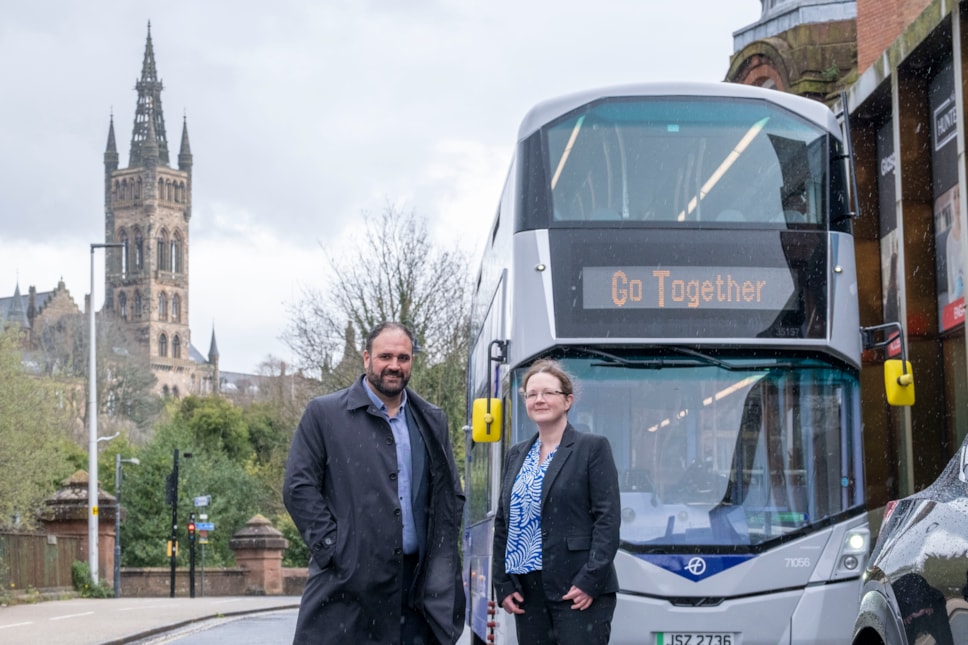
Picture caption: Andrew Cullen and Dr Fiona Crawford launch the report at the University of Glasgow.
Ends
Notes to editors
All figures, unless otherwise stated, are from The Price of Bus Delays report undertaken by the University of Glasgow which can be accessed here The Price of Bus Delays in Glasgow: An economic valuation of bus passenger time lost due to congestion in Glasgow. The analysis is based on timetable, On-Time Performance, and boarding data for 2024. Only weekday data for First Bus services on five Glasgow corridors were included. Values of travel time were obtained from the Scottish Transport Appraisal Guidance (STAG).